

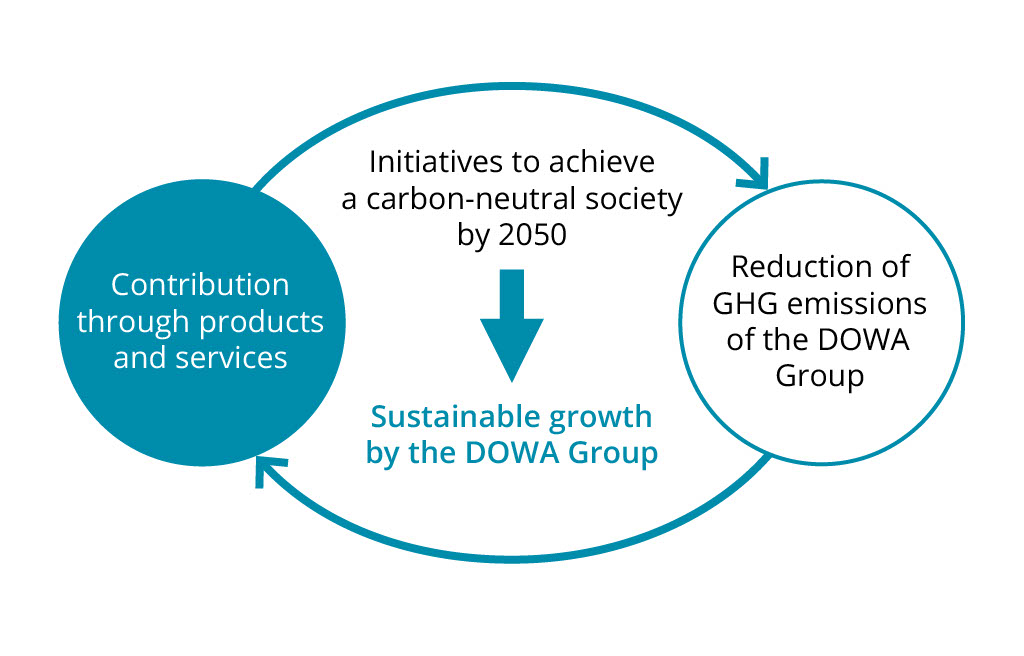
Climate change is a serious social challenge facing all industries and people around the world. In light of the current situation of advancing global warming, the DOWA Group is working to address climate change from the perspectives of both reducing risks and seizing opportunities. By addressing climate change through both the reduction of our GHG emissions and the creation and expansion of products and services that contribute to society’s efforts to combat climate change, we aim to achieve a carbon-neutral society by 2050, leading to the sustainable growth of our Group.
We have designated addressing climate change as one of our Materiality and promote activities aimed at achieving carbon neutrality by 2050. In 2022, we reaffirmed our stance on climate change within and outside the Group by endorsing the TCFD recommendations. Based on the framework of the TCFD recommendations, we also conducted a scenario analysis and summarized the business risks and opportunities arising from climate change and published the TCFD Report.
-
 TCFD Report
(1,550KB)
TCFD Report
(1,550KB)
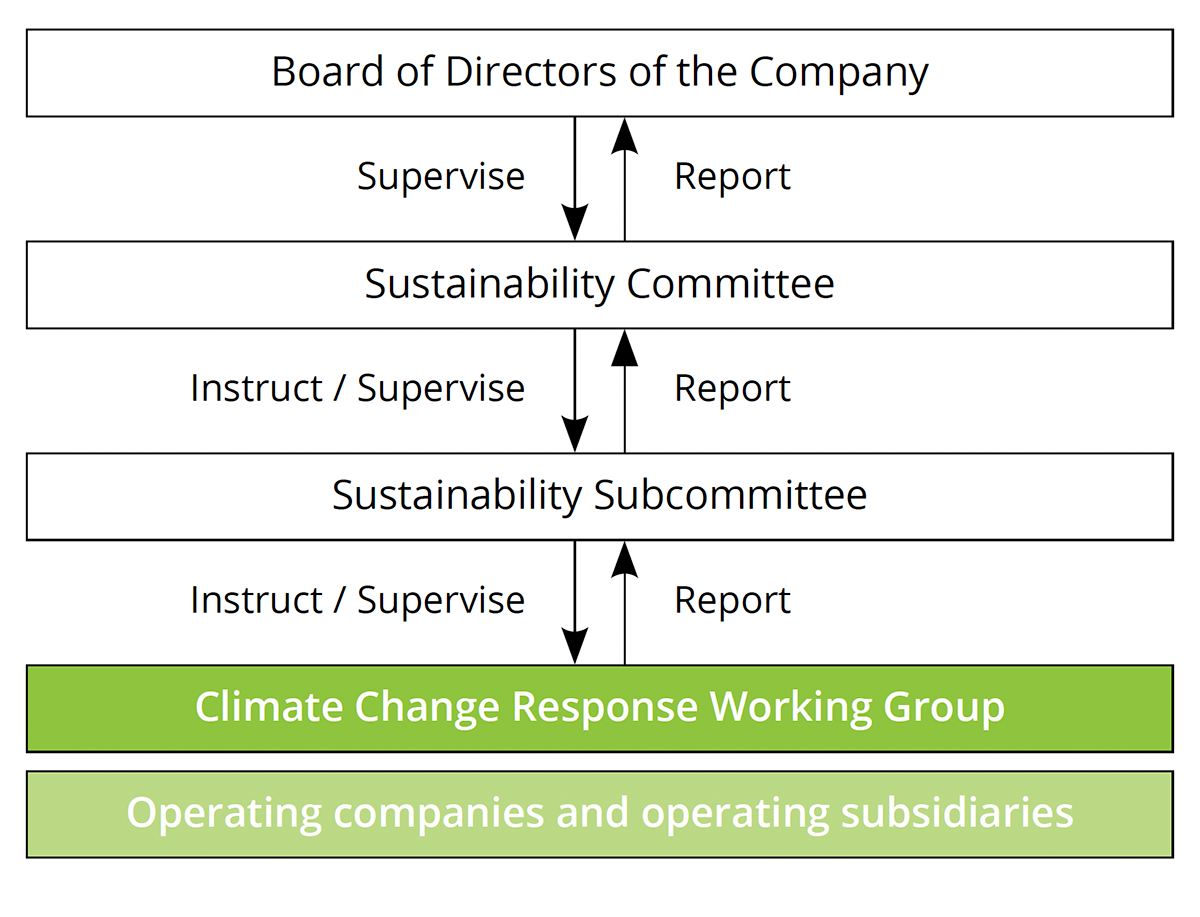
In order to enhance sustainability-related activities, including those targeting climate change, the Group established the Sustainability Committee, which is chaired by the President and Representative Director, and under it the Sustainability Subcommittee, which is chaired by the director in charge of corporate strategy.
〈Sustainability Committee〉
Deliberates on managing risks and opportunities related to climate change issues, and important matters related to management risks and opportunities are brought to the Board of Directors for discussion and reporting. Upon receiving the agenda and reports from the committee, the Board of Directors shares issues related to climate change and discusses target management and solutions to these issues.
〈Sustainability Subcommittee〉
Identifies and assesses risks and opportunities presented by climate change, looking at the issue from a Group-wide perspective, and then investigates and formulates action plans, goals, and countermeasures, which it then reports to the Sustainability Committee along with any important risks and opportunities.
〈Climate Change Response Working Group〉
Consists primarily of members from operating companies and members of the Technologies Department. Shares information related to climate change internally and externally while engaging in activities to implement specific measures against climate change, such as promoting initiatives that include reduction plans for GHG emissions and climate change monitoring systems.
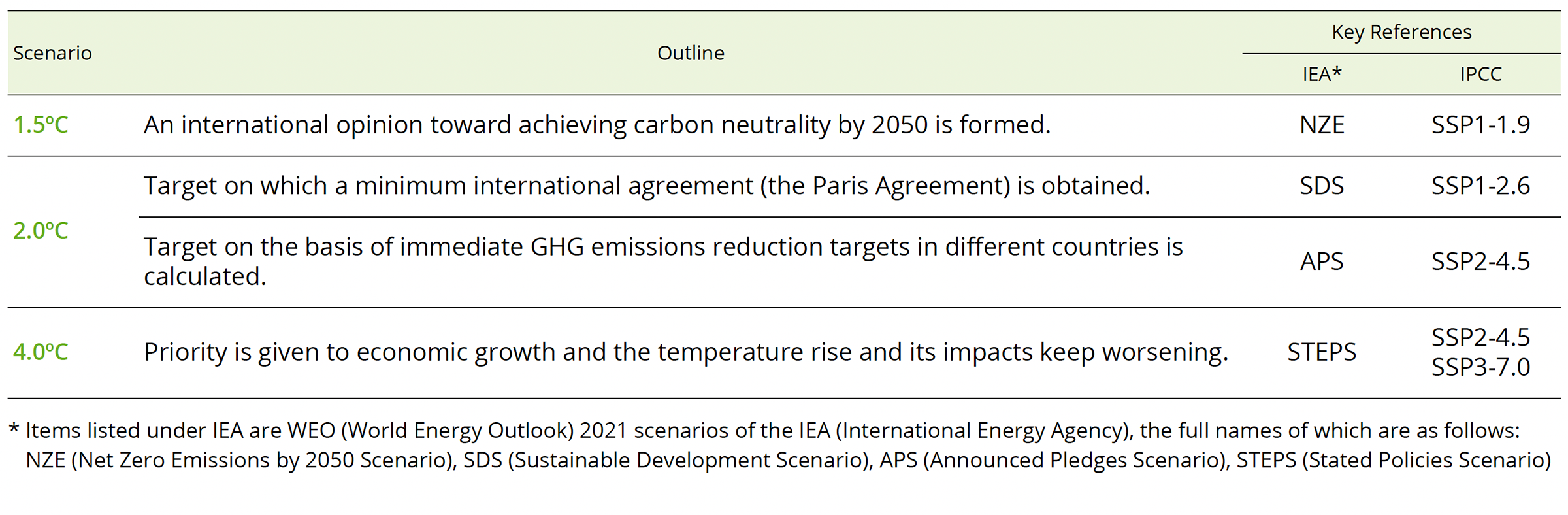
To identify risks and opportunities that climate change could pose for the Group’s business, we deliberated based on multiple scenarios from 1.5℃ to 4℃, identified risks and opportunities related to climate change in short (by 2025), medium (by 2030), and long (by 2050) time frames, and summarized our analysis and evaluation in a TCFD report that we published in 2022. In fiscal 2024, with the establishment of Medium-term Plan 2027, we updated our short- and medium-term outlooks, created common prediction scenarios for the whole of the Company, and organized current issues in each business, after which we reviewed our risks and opportunities and established a three-year execution plan.
As a measure to address opportunities with significant financial impacts identified through our scenario analysis, we have designated products and services that contribute to society’s efforts to address climate change as “DOWA Green Action” (DGA) and have set a sales target for fiscal 2030. In addition to reducing our own GHG emissions, we aim to contribute to the reduction of climate-related risks across society as a whole and to the realization of a decarbonized society by expanding these products and services.
- Provision of materials that contribute to the realization of a decarbonized society through resource recycling
- Products and services that contribute to climate change responses by customers and society
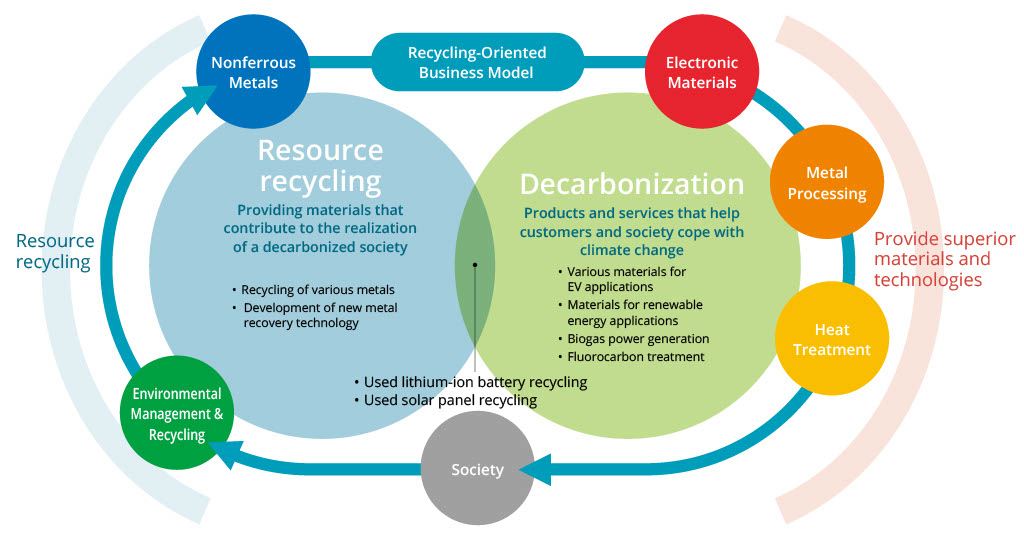
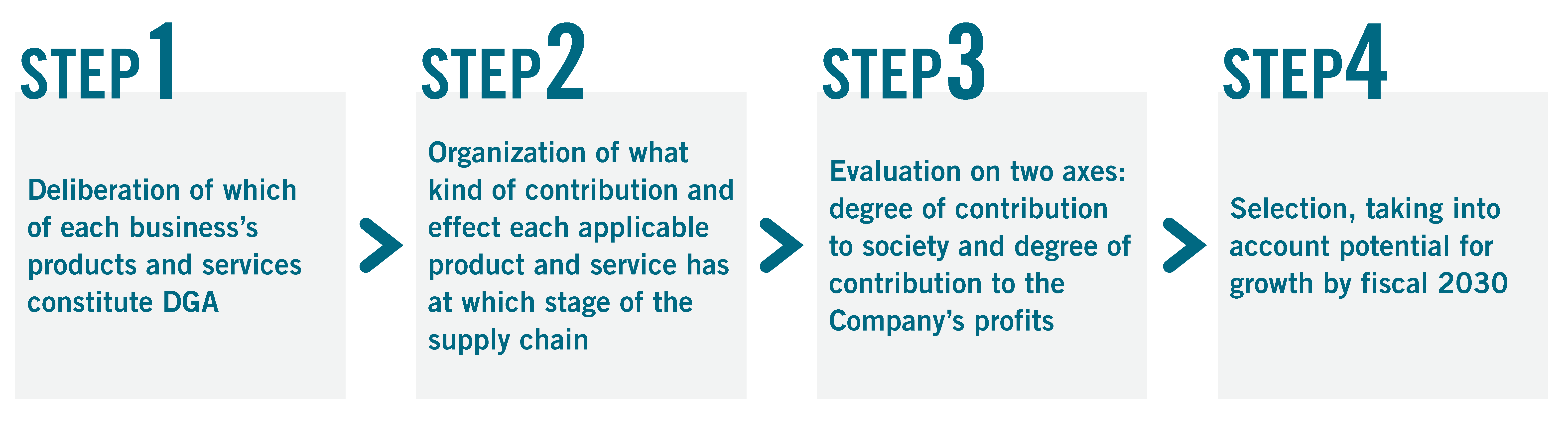
For DGA, each of our businesses examines which products and services qualify as DGA and organizes how and at which stages of the supply chain the selected products and services contribute value. Based on this analysis, they are evaluated along two axes—“their level of contribution to society" and “their contribution to our business performance”—and are selected with consideration given to their growth potential toward fiscal 2030.
In 2023, we formulated a roadmap for achieving carbon neutrality by 2050. We will make maximum use of existing technologies to reduce GHG emissions and systematically work to introduce new technologies. In addition to energy conservation, renewable energy, fuel conversion, electrification, and other measures, we will actively promote in-house development of biomass fuels, ammonia burners, and other inhouse initiatives. In the future, we will promote climate change countermeasures through multiple options, such as considering the use of negative emission technologies that capture and store CO2.
We have positioned risk management as one of our Materiality. We strive to enhance risk management by establishing a system to appropriately manage and mitigate various risks arising through our business activities. Risk management related to climate change is integrated into the Group’s overall risk management.
In recent years, weather disasters such as heavy rain and typhoons have become more severe and frequent, making it increasingly important to prepare for weather disasters. In response to the physical risks of climate change, in fiscal 2023, the DOWA Group conducted a location risk survey on vulnerability to natural disasters at all domestic production bases. We conducted risk assessments covering a wide range of disasters, including floods, inundation, high tides, and landslides, as well as earthquakes, tsunamis, and volcanoes. We held inhouse briefings to share the results of the assessments with the entire company.
After sorting out the risks for each location by event, we are incorporating them into the BCP and disaster prevention plans of each base and taking measures for particularly high-priority disasters and regions.
To achieve carbon neutrality by 2050 and to link our efforts to address climate change to the sustainable growth of the Group, we have set contribution targets through products and services and GHG emissions reduction targets as interim targets for fiscal 2030.
The Group aims to be carbon-neutral by 2050 and, as a milestone, has set an interim goal of reducing Scope 1 and Scope 2 GHG emissions in Japan compared to fiscal 2013 levels by fiscal 2030, as shown in the table below.
|
CO2 derived from electricity and fossil fuels |
Manufacturing sites |
At least 38% reduction (from FY2013 levels) |
|
Transportation sites |
At least 35% reduction (from FY2013 levels) |
|
|
Waste management sites and offices |
At least 51% reduction (from FY2013 levels) |
|
|
CO2 derived from incinerated waste |
At least 15% reduction (from FY2013 levels) |
|
Note: This target includes reductions through the use of credits and other means that represent Scope 1 and Scope 2 GHG emissions (CO2 equivalent) emitted by the DOWA Group in Japan.
By expanding the supply of DGA products and services and striving to develop technologies and create new businesses, we will contribute to the reduction of GHG emissions throughout society and work toward the realization of a carbon-neutral society. We set a sales target for DGA products and services as an indicator of these growth targets. As we advance, we will compile actual sales of DGA products and services each year to manage progress. To achieve our goals, we will steadily invest in growth in each of our businesses, as defined in our Midterm Plan 2024. We will also conduct research and technological development utilizing the ESG investment in our Midterm Plan 2024 to expand new DGA products and services.
Under Medium-term Plan 2024, we established a framework for implementation of climate change action throughout the Group, and published a TCFD report and a roadmap for achieving carbon neutrality in 2050. We are using the name DOWA Green Action for products and services that contribute to society’s response to climate change, and have rolled out activities in line with TCFD, such as setting new goals for fiscal 2030.
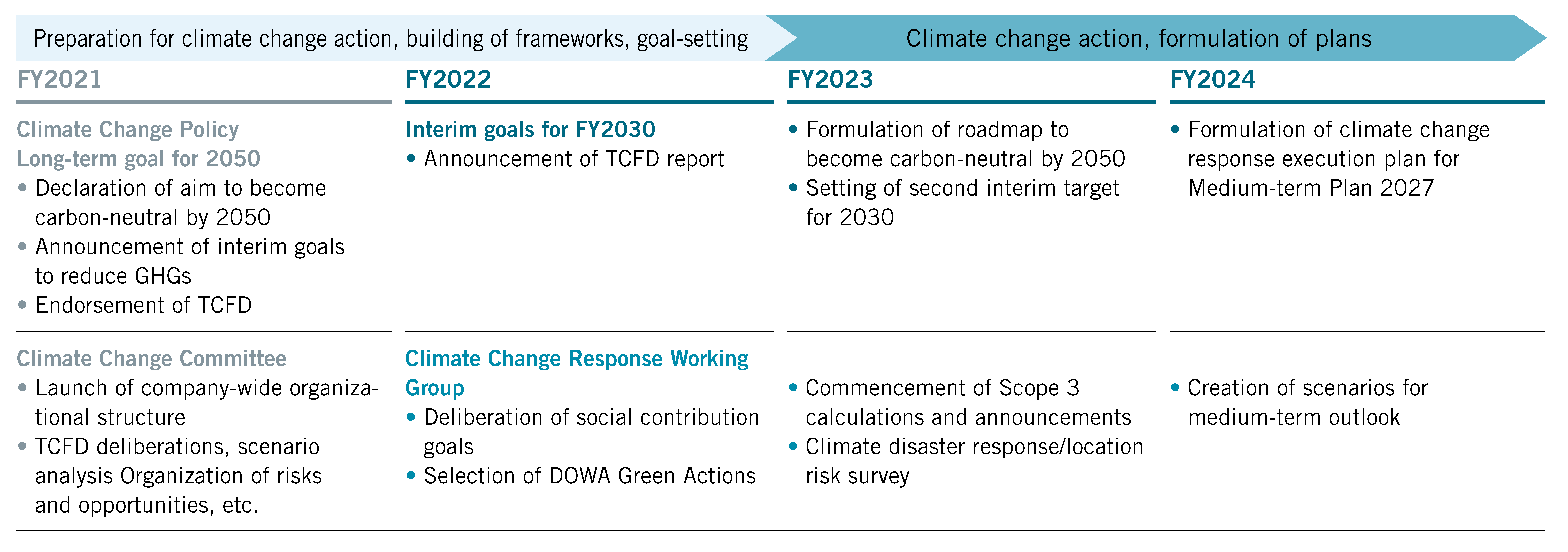
|
Key measures |
Indicators |
Targets |
FY2024 results |
|
Promotion of company-wide activities to combat climate change |
Establishment of a system to promote climate change response |
- Publication of TCFD Report - Create a roadmap for climate change response |
- Revised medium-term scenarios based on TCFD report and roadmap for climate change response (the report and roadmap were announced by fiscal 2023) - Created climate change response execution plan |
|
Establishment of Company-wide policies and targets for climate change response |
|||
|
TCFD initiatives |
With the formulation of Medium-term Plan 2027, we formulated an execution plan for fiscal 2025 to 2027. When formulating the plan, we set common scenarios regarding social trends to form the basis of our deliberation, based on situational changes related to climate change in recent years, and reviewed the risks and opportunities for each business. We also considered measures to focus on during the three-year period until fiscal 2027 in order to meet our GHG emission reduction targets and DGA targets for fiscal 2030, based on the business environment and issues of each business.
Based on projections of changes in the external environment through 2035, we identified the key factors that may have an impact on our business.
|
Climate Change
|
|
- Rising temperatures - Natural disasters, etc.
|
|
Energy
|
|
- Power generation mix - Renewable energy - Energy prices, etc.
|
|
Information Disclosure
|
|
- TCFD/SSBJ - Scope 3, etc.
|
|
Regulations and Frameworks |
|
- GX-related measures - Emissions trading and fossil fuel levies - Fiscal and monetary policies, etc. |
|
Market and Technological Trends |
|
- Circular economy - DX, Automotive, etc.
|
|
Premises |
• The Company will focus on both metal recycling and our waste treatment business • Incineration of waste is essential social infrastructure for public sanitation and safety, as well as waste reduction and recycling • It is difficult to build new domestic sites for final disposal, so extending the life of existing treatment sites is a key social challenge |
|
Challenges |
• GHG emissions from incineration are difficult to control as they come from waste from external sources • Promotion of understanding of the social value played by treatment of hazardous waste, which supports resource recycling systems • Reduction of GHG emissions will require comprehensive perspectives and initiatives for interconnected challenges such as environmental protection and circular economies |
|
Our approach |
• Promotion of lower-carbon waste treatment by introducing effective technology and processes • Strengthening of dissemination of information on the need for waste treatment and external costs • Expansion of GHG emission reduction in society through measures such as destruction of fluorocarbons • Comprehensive promotion of decarbonization, environmental protection, and resource recycling to build a sustainable society |
Climate Change Measures Balanced with Making Our Businesses More Competitive
• Decisively implement climate change response execution plan with a view to fiscal 2030
• Confirm overall progress through annual monitoring
• Review measures and plans flexibly in response to social trends
|
Areas of Initiatives to Realize a Decarbonized Society |
Initiatives |
|
|
Reduction of the Company’s GHG emissions |
Promotion of energy saving |
• Energy saving through facility improvement • Switching to energy-efficient devices |
|
Expansion of renewable energy |
• Purchasing of electricity from renewable energy • Installation of solar power facilities • Introduction of small hydroelectric power facilities |
|
|
Transition to low-carbon fuel |
• Development of solid biomass fuel and replacement of coal coke • Transition from heavy oil and LPG to city gas and electricity |
|
|
Other |
• Offsets through purchase of credits |
|
|
Contribution to reduction of GHGs in society (contributions through DOWA Green Actions) |
Contribution to climate change action |
• Compound oxide powder for fuel cell materials • Non-fossil energy (biogas power generation) • Metal-ceramic substrates for power modules • Highly functional copper alloys for EVs • Zero-CO2 industrial furnaces |
|
Promotion of circular economy |
• Recycled metals and metal products with third-party certification • PV recycling, dismantling and treatment of wind power facilities • Recycling of spent lithium-ion batteries (LIB) |
|
|
Adaptation to climate risks |
Reduction of impact on business activities |
• Reviews of disaster prevention plans and BCPs based on risk assessments • Introduction of system for management of natural disaster risks in supply chain • Measures against heat at production sites |
With the formulation of Medium-term Plan 2027, we reviewed the contribution and effect achieved by each of the Group’s products and services in fiscal 2024 based on market trends and situational changes in the Company. Based on the results, we set a target for 50 or more DGA categories by fiscal 2027 (there are 22 categories as of the end of fiscal 2024).
|
Key measures |
Indicators |
Targets |
|
Management for GHG reduction |
GHG emissions (Scope 1 and 2) |
Reduction by 22% compared to FY2013 (FY2027) |
|
Creating and expanding products and services that contribute to society's measures to combat climate change |
Number of items of DOWA Green Action (FY2024:22 items) |
50 items or higher (FY2027) |
The Group’s greenhouse gas emissions are characterized by the fact that they are primarily of electricity-derived and waste-derived, accounting for about 80% of total emissions. CO2 emissions are particularly affected by the incineration of waste received from outside sources, which varies depending on the amount and composition of the waste. Since it is difficult to control these factors, we are actively promoting thermal recycling, which uses the heat generated during incineration to generate electricity or produce steam. Furthermore, we are working to utilize and expand natural energy sources such as hydroelectric power and solar power. At our manufacturing bases, we are working to reduce CO2 emissions by switching to more energy-efficient equipment and reducing energy consumption through appropriate operational management. Additionally, we recognize the importance of understanding the GHG emissions throughout our supply chain and are advancing the calculation and disclosure of Scope 3 emissions, which are associated with corporate activities. By visualizing our CO2 emissions within the supply chain, we aim to identify points of reduction and will continue to strive for improvements in the accuracy of our calculated values.
We will continue to promote energy conservation by improving processes and reduce greenhouse gas emissions by switching fuel sources and utilizing renewable energy in an effort to achieve the Group’s medium- to long-term goals.
Creating Energy from Food Waste
BIODIESEL OKAYAMA CO., LTD. accepts cooking scraps and discarded food from convenience stores, supermarkets, and school lunches, generates methane gas, and uses this gas to generate electricity equivalent to the annual electricity consumption of approximately 1,600 households. Recycling of food that is discarded after the distribution stage has not progressed because it is difficult to separate it from its packaging. However, this facility has installed preprocessing equipment to remove packaging and other waste, and is using food waste that is difficult to recycle as an energy source.
Support for Automotive Supply Chain Decarbonization
Heat treatment, which gives automobile and industrial equipment parts properties such as durability and wear resistance, consumes a large amount of energy. However, our heat treatment furnace Z-TKM aims to save energy by shortening lead times and minimizing fuel use,reducing CO2 emissions by approximately 40% compared to conventional methods. In addition, by combining ammonia and hydrogen burners,we can operate with almost no CO2 emissions during the process, contributing to the decarbonization of manufacturing supply chains that includes automobile production.
Addressing the Waste Problem of Renewable Energy
The number of solar (PV) panels has increased rapidly due to the Feed-in-Tariff (FIT) system in recent years. These panels are expected tobe discarded in large quantities from around 2033 when the FIT system ends. DOWA is working to recycle resources by establishing an integrated processing system that covers everything from the collection and transportation of used solar panels to recycling and conversion into smelting raw materials, with the aim of recycling (metal and heat recovery) used PV panels. Current mainstream silicon solar panels use valuable metals such as silver and copper, and some also contain lead. However, DOWA’s scheme allows us to coordinate recycling and waste disposal in-house, allowing us to efficiently manage hazardous substances and recover resources.
Contribution to GHG Emission Reductions through Fluorocarbon Destruction
CFCs, HCFCs, HFCs, and other fluorocarbons used as refrigerants in refrigeration and air conditioning equipment have a substantial greenhouse effect, ranging from several hundred to more than 10,000 times that of CO2, so proper treatment is essential. We have cooperated with the Ministry of the Environment’s Fluorocarbon Destruction Model Projects and have contributed to the establishment of fluorocarbonrelated legislation and the strengthening of regulations by conducting demonstration tests, etc., in cooperation with national and local governments. Currently, our Group contributes to reducing GHG emissions by more than 1 million tons (CO2 equivalent) per year, including fluorocarbons recovered and recycled from home appliances and fluorocarbons destroyed by thermal decomposition. In the destruction process, we perform thermal decomposition by waste heat from the incineration of waste materials without inputting new energy, thereby reducing our own GHG emissions in our endeavor to prevent global warming. We are also expanding fluorocarbon treatment in Thailand and other countries, which is expected to contribute to GHG emission reductions of more than 10,000 tons per year (CO2 equivalent) in a bilateral credit project supported by the Japanese government.
We are working to combat global warming through the use of in-house power generation from renewable energy sources and the promotion of renewable energy through our business.
In 1897, the Company began operating Japan’s second hydroelectric power plant for mining development. Since then, the Company has continued to expand and upgrade its facilities as its business has grown, and it currently owns six hydroelectric power plants in Akita Prefecture. Making it an important energy source for Kosaka Smelting & Refining Co., Ltd.
We are working to expand the use of renewable energy by installing solar power generation systems at 12 of our business sites in Japan and overseas. In addition to being used as part of the electricity required for business activities, some electricity was sold back to the grid.
We are working on biomass gas power generation from food waste in Okayama Prefecture.
The Group generates waste heat at six sites, five in Japan and one overseas. Waste heat power generation is a method that uses the heat from incinerating waste materials and exhaust heat from furnaces to produce high-temperature, high-pressure steam that turns turbines to generate electricity. Energy can be generated from waste, leading to the curtailment of fossil fuels.
In April 2022, we set up the DOWA x Tohoku University Co-creation Research Center with the aim of bolstering our research activities with Tohoku University. The exceptional technological seeds at Tohoku University and the technology possessed by DOWA will be further integrated. The goal of this joint project is to create cutting-edge technology that will contribute toward offering resource recycling and excellent materials and technology while also responding to sustainability issues, including carbon neutrality. In the initial phase, from fiscal 2022 to fiscal 2024, we will explore the following themes and aim at launching collaborative research projects.

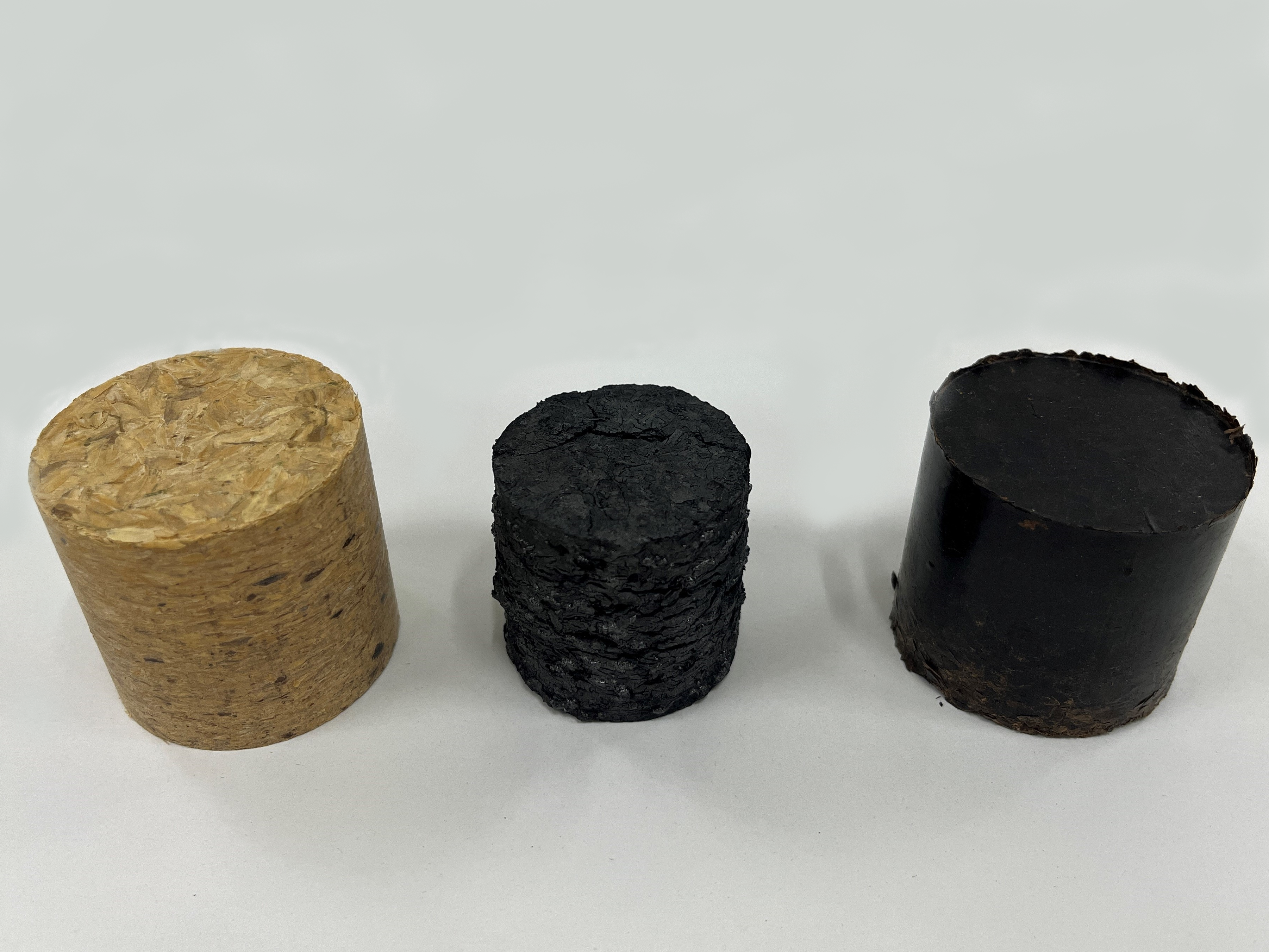
DOWA ECO-SYSTEM CO., LTD. has introduced production and fuel evaluation equipment for Bio-coke (“BIC”), biomass solid fuels expected to replace fossil fuels in the future, at its Research and Development Center. This makes DOWA ECO-SYSTEM the first private-sector company to build a system that can handle all processes from development to production and quality evaluation for BIC.
Since BIC can utilize raw materials such as waste plastics in addition to biomass raw materials, it is expected that further effective use of waste resources will be achieved by linking it with existing waste treatment businesses of DOWA ECO-SYSTEM.
With a view to expanding the production and sales business of BIC at domestic and overseas bases under DOWA ECO-SYSTEM in the future, DOWA ECO-SYSTEM will work to expand the use of BIC, by building relationships with various raw material suppliers and BIC users, engaging in stable procurement of raw materials, and developing products that meet customer needs.
As part of our response to climate change issues, we promote ”mitigation measures” to reduce greenhouse gas emissions, such as renewable energy and energy saving. In addition, we are also taking action in terms of ”adaptation measures”, such as disaster response and heat stroke countermeasures.
|
Heat Stroke Prevention Measures |
|
|
Weather Disasters |
|
We are a member of the Japan Mining Industry Association (JMA) and participates in the JMA’s specialized committees and subcommittees on climate change. The Japan Mining Industry Association has published “The Non-Ferrous Metals Industry’s Efforts to Achieve Carbon Neutrality by 2050,” and shares information with its member companies and collaborates with them in their efforts to achieve this goal. We regularly confirm that these industry associations are consistent with our approach and direction, and if there is any significant weakness or inconsistency, we will consult internally and with the industry associations and make adjustments so that our climate change strategy and activities with the industry associations are aligned.
DOWA ECO-SYSTEM CO., LTD., the environmental business of the DOWA Group, has been a full member of the Climate Leaders’ Partnership (JCLP) since 2014. JCLP was established in recognition of the need for industry to develop a healthy sense of urgency and take proactive action to achieve a sustainable decarbonized society JCLP is an economic organization unique to Japan. By leading the transition to a decarbonized society, we aim to become a company that is sought after by society.