

The DOWA Group is working to further enhance corporate social responsibility (CSR) while strengthening partnerships with its suppliers by helping them understand the importance of CSR in the supply chain. We will also work to conserve biodiversity by conducting our business activities in a manner that takes biodiversity and ecosystems into consideration throughout our supply chain.
In order to promote sustainability throughout our supply chain, the DOWA Group established the “DOWA Group CSR Procurement Guidelines” for our suppliers in FY2014, and has been revising the Guidelines (currently in Version 1.6) as necessary in response to social conditions. Based on our “CSR Procurement Policy” and “Responsible Mineral Procurement Policy,” the Guidelines present the DOWA Group’s basic approach and code of conduct for CSR procurement, and we request that our suppliers understand our promotion of sustainability management and comply with the Guidelines. We also inform our suppliers of our compliance with the Guidelines when we distribute our annual self-checklist and when we start new transactions with them. In addition, our CSR procurement-related policies are widely publicized on our website.

|
(1) Legal Compliance and Fair Trade |
(2) Optimal Quality and Fair Price |
(3) Establishing a Stable Supply System |
(4) Sustainability |
(5) Information Protection |
(6) Management System |
|||
|
1) Human rights and labor |
2) Occupational health and safety |
3) Environmental conservation |
4) Contributions to society and local communities |
|||||
|
|
|
|
|
|
General matters |
|
|
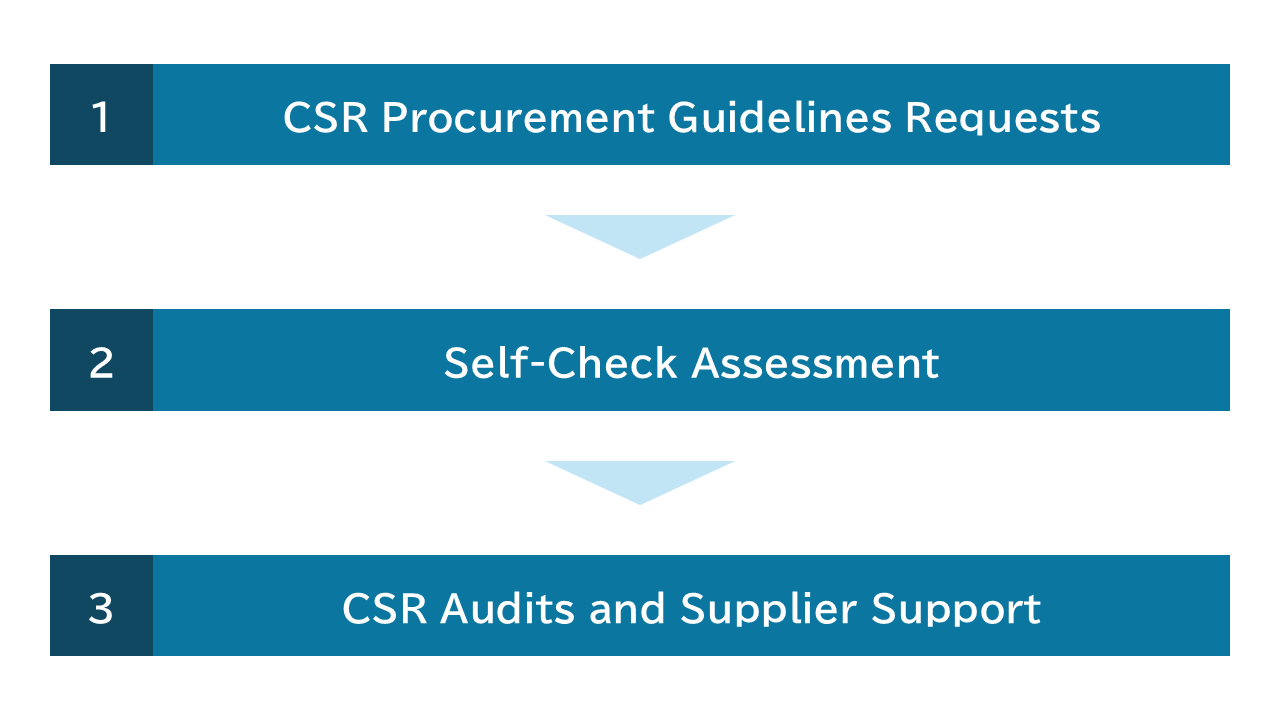
Within the Group, we implement supply chain management based on our “CSR Procurement Policy” and “CSR Procurement Guidelines” in order to promote CSR procurement throughout the entire supply chain.
As suppliers are important partners of the Group, their understanding of and cooperation with our CSR procurement initiatives are essential. Accordingly, we request that suppliers comply with the CSR Procurement Guidelines, which set forth the Group’s basic approach and code of conduct for CSR procurement. In addition, each year we conduct risk assessments of existing key suppliers and new suppliers through CSR questionnaires based on the CSR Procurement Guidelines. Furthermore, for suppliers identified as having high risks based on the results of the CSR questionnaires and our own materiality assessments, we conduct CSR audits.
Based on the results of the CSR questionnaires and CSR audits, we provide improvement support to suppliers, including the sharing of best practices and guidance on corrective actions. Through such supply chain management initiatives, we will continue to promote CSR procurement.
- 拡大
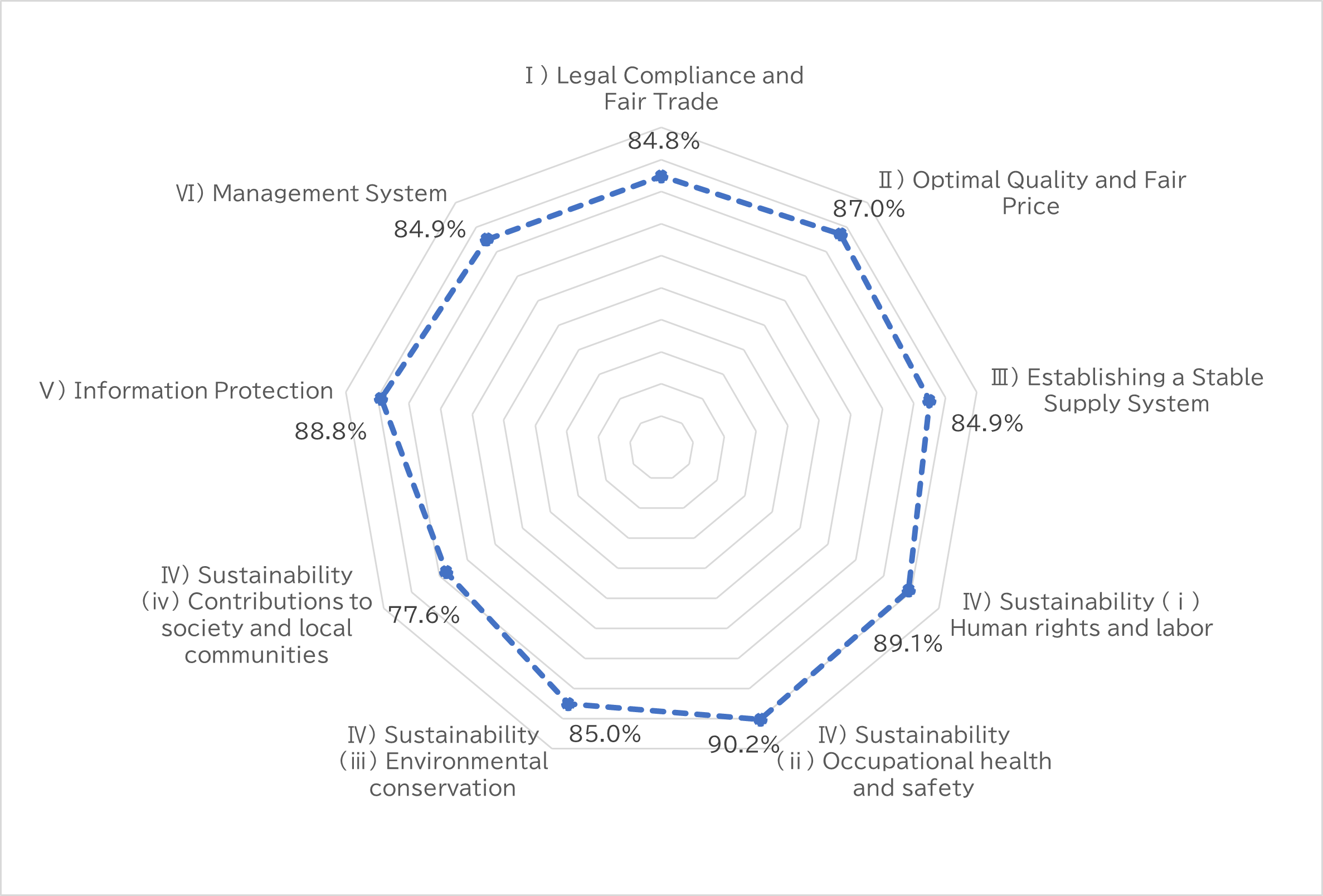
- Self-Check Assessment Results (FY2024)
Each year, the Group distributes a self-checklist based on the “CSR Procurement Guidelines” to its suppliers and evaluates their initiatives, including their frameworks and actual practices for promoting sustainability. Through this CSR questionnaire, we assess suppliers from the perspectives of “Legal compliance and fair transactions,” “Optimal quality and appropriate pricing,” “Establishment of a stable supply system,” “Sustainability (human rights and labor, occupational health and safety, environmental protection, and social and community contributions),” “Information security,” and “Management systems,” and continuously identify issues within the supply chain.
Suppliers that respond to the questionnaire receive a feedback report outlining our expectations and areas for improvement, through which we request their continued efforts to promote sustainability.
In fiscal 2024, the self-checklist was distributed to more than 240 existing key suppliers and new suppliers, and responses were collected from approximately 81% of them.
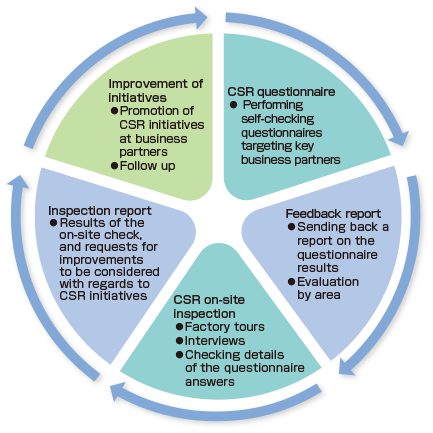
Since fiscal 2015, the Group has identified high-risk suppliers from environmental and social perspectives based on the results of self-check assessments and other information, and has conducted CSR audits as necessary. Through CSR audits, we communicate our CSR initiatives, CSR Procurement Guidelines, and social conditions related to the supply chain to our business partners, and conduct interviews based on the self-check assessments. These audits focus primarily on areas such as “Human rights and labor,” “Occupational health and safety,” “Environmental protection,” and “Social and community contributions,” and are used to confirm the status of sustainability initiatives and working conditions at suppliers’ sites.
After the audits, we provide feedback on the audit results to the audited suppliers in the form of written reports. In this feedback, we recognize and evaluate good practices, while also identifying areas for improvement and requesting corrective actions where necessary. If suppliers are unclear about specific corrective measures, we support improvement efforts by sharing best practices and providing guidance on appropriate responses. In addition, CSR audits are conducted with the participation of not only our sustainability and procurement departments, but also personnel responsible for materials related to the audited suppliers, thereby strengthening relationships of trust with suppliers and further promoting awareness of our CSR procurement initiatives within the Group.
In fiscal 2024, three CSR audits were conducted. Issues identified included hazardous areas in manufacturing equipment and insufficient records of occupational accidents, and requests for improvement were made in response to these findings.
Responsible Procurement of Minerals Companies that handle metals such as those that comprise the DOWA Group have a social responsibility to procure minerals while remaining mindful of human rights, the environment, ethics, and similar concerns. We live in a time when products that utilize metal, such as automobiles, electronic devices, and electric appliances, continue to grow in number, are distributed around the world, and support us in our daily lives. Regardless of whether information is disclosed or not, we believe that the procurement of ore, which is the raw material for these products, should not prolong conflicts or come at the cost of human rights violations.
The Company has established the DOWA Group Responsible Minerals Procurement Policy and does not use minerals as raw materials if those minerals may be used to fund organizations involved in human rights violations and other illegal activities in conflict-affected or high-risk areas. We conduct due diligence for all suppliers from whom we procure materials, including tantalum, tungsten, gold, silver, tin, and zinc, and respond appropriately whenever a potential risk is identified. During our due diligence process, we act in accordance with the OECD Due Diligence Guidance for Responsible Supply Chains of Minerals from Conflict-Affected and High-Risk Areas.
In addition, the DOWA Group produces various types of metals, including gold and silver, at its domestic smelters. These smelters are regularly audited by thirdparty organizations to ensure that our metals are safe for all customers and that our systems and practices for responsible mineral management are being audited. In our effort to ensure responsible mineral procurement, we have built a metal supply system that is not connected to conflicts or human rights violations.
We consider the establishment of this system to be a necessary part of our role as a smelter operator upstream in the supply chain.
We have undergone the independent third-party assessments of responsible mineral procurement in accordance with the “LBMA Responsible Silver Guidance” and the “Joint Due Diligence Standard for Copper, Lead, Molybdenum, Nickel and Zinc”.
Since the DOWA Group primarily engages in business-to-business transactions, disruptions along the supply chain will have a severe impact on the production and sales activities of customers receiving our services or products. Therefore, through CSR procurement, we regularly confirm with our major suppliers that they have in place a BCP to ensure that we can restore and continue business promptly.
The Group requests its suppliers to protect the environment in its CSR procurement guidelines and works to reduce environmental impact throughout the supply chain. By asking suppliers to establish environmental management systems, the Group encourages them to engage in environmental activities such as nature conservation and reducing their environmental impact.
The DOWA Group holds study sessions on CSR procurement once or twice a year at meetings of purchasing managers within the Group, in order to reflect the spirit expressed in the CSR Procurement Policy and CSR Procurement Guidelines in its procurement activities. The meetings are designed to share information on sustainability risks in the supply chain and to raise awareness by learning about the importance of management and other aspects of sustainability.
With regard to supply chain management, there is a social demand to address not only raw material procurement but also the entire supply chain related to a series of business processes from development, production, sales, and services, and the HD Group also receives CSR procurement-related requests from our suppliers. In order to respond to these requests promptly and appropriately, the HD, operating companies and operating subsidiaries shall cooperate with each other and respond to such requests among their sales, manufacturing, procurement, human resources, general affairs, sustainability, and other divisions.
We actively participate in activities led by the Global Compact Network Japan (GCNJ), a local network of the UNGC in Japan. We have participated as a member of the GCNJ Supply Chain Working Group since 2017, and have created educational tools for CSR procurement and practical tools for CSR procurement managers with other participating companies to have the spirit of the four areas and ten principles of the UNGC be reflected in the supply chain.